
Quick Summary: Real estate owners can achieve maximum tax savings on appreciated real estate by combining the Internal Revenue Code Section 121 primary residence gain exclusion with a Section 1031 tax-deferred exchange. Under IRS Revenue Procedure 2005-14, highly appreciated primary residences converted into rental properties (or mixed-use properties) qualify for a dual tax treatment. Property owners can permanently exclude up to $250,000 (single) or $500,000 (married filing jointly) in capital gains tax-free, while simultaneously rolling the remaining gain and cash proceeds into a replacement rental property via a 1031 exchange.
How IRS Revenue Procedure 2005-14 Unlocks Dual Tax Relief
When selling a highly appreciated primary residence or investment property in California, property owners face steep capital gains taxes, net investment income tax (NIIT), and state income tax rates.
Under normal IRS rules, IRC Section 121 allows homeowners to exclude up to $250,000 (single) or $500,000 (married filing jointly) of gain from their primary residence. Meanwhile, IRC Section 1031 allows investors to defer capital gains on business or rental properties by rolling proceeds into a like-kind replacement property.
Under IRS Revenue Procedure 2005-14, property owners can combine both tax strategies on a single real estate transaction.
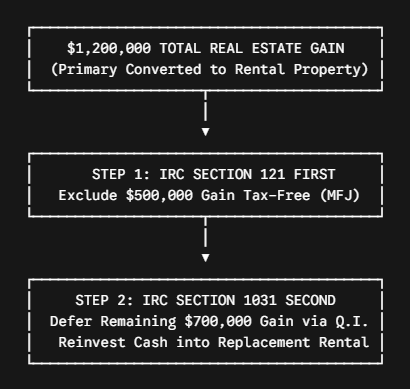
Here is a guide on how to combine Section 121 and Section 1031, the eligibility requirements, and real-world execution strategies.
1. How Revenue Procedure 2005-14 Works
Under IRS guidance, when a property satisfies the requirements for both Section 121 (primary residence) and Section 1031 (investment/rental use), the Section 121 exclusion is applied first before applying Section 1031 deferral rules.
2. Scenario 1: Converting a Primary Residence into a Rental Property
The most common way to combine both code sections is converting your personal home into a rental property.
The 2-in-5-Year Ownership & Use Rules
To qualify for Section 121, you must have owned and used the property as your primary residence for at least 2 out of the 5 years prior to the sale date.
- Move Out & Rent: Move out of your home and rent it to tenants for 12 to 24 months. This establishes investment intent to satisfy Section 1031 exchange rules (Revenue Procedure 2008-16 safe harbor).
- Sell Within 3 Years of Moving Out: Because you lived in the home for 2 of the prior 5 years, you still meet the Section 121 primary residence test.
- Apply Section 121 First: Take your tax-free $250,000 or $500,000 exclusion in tax-free cash proceeds.
- Defer the Rest via 1031: Direct the remaining sale proceeds to a Qualified Intermediary (QI) to purchase replacement investment property, deferring all remaining capital gains and depreciation recapture.
3. Scenario 2: Mixed-Use Properties (Duplexes & Home Offices)
If you own a mixed-use real estate asset—such as a duplex where you occupy one unit and rent the other, or a multi-family property—you do not need to convert the property over time.
- Primary Residence Portion: Apply Section 121 directly to the square footage allocated for your personal residence.
- Rental / Investment Portion: Execute a 1031 exchange on the square footage allocated for the rental or business unit.
4. Scenario 3: Rental Property Converted to Primary Residence
If you acquired an investment property via a prior 1031 exchange and later moved into it:
- 5-Year Ownership Rule: You must own the property for at least 5 total years before claiming Section 121 benefits on a former 1031 replacement property.
- Non-Qualified Use Rules: Capital gains must be allocated between “qualified use” (primary residence years) and “non-qualified use” (rental years). Gain attributable to non-qualified rental years cannot be excluded under Section 121 but can be deferred via a new 1031 exchange.
Optimize Your Real Estate Tax Strategy Today
Combining Section 121 and Section 1031 requires precise timing, qualified intermediary coordination, and basis tracking.
At Moontree Tax Service, we specialize in real estate tax strategy, 1031 exchange planning, Schedule E rental tracking, and capital gains minimization for property owners and investors across Silicon Valley and California.
Schedule a Real Estate Tax Strategy Call Today or call us directly at (408) 475-2306.
Disclaimer: This article is intended solely for educational and informational purposes and does not constitute formal legal, accounting, or tax advice. Tax laws change frequently and apply differently based on individual financial profiles and transaction timing.