
Quick Summary: The IRS optional standard mileage rate allows self-employed individuals, small business owners, and qualifying taxpayers to deduct the operating costs of an automobile used for business, medical, moving, or charitable travel. Business taxpayers can choose between using the flat standard mileage deduction or tracking actual vehicle expenses (gas, insurance, maintenance, and Section 179 depreciation). Taxpayers must select the standard mileage rate in the first year a vehicle is placed in service for business use to retain the flexibility to switch between methods in future tax years.
Maximizing Business Vehicle Write-Offs: Standard Mileage vs. Actual Expenses
For small business owners, 1099 independent contractors, and real estate agents in California, vehicle operational expenses represent one of the most consistent annual tax deductions.
The IRS provides two distinct methods for writing off business vehicle use: the Standard Mileage Rate or the Actual Expense Method.
Choosing the correct method—and maintaining contemporaneous mileage logbooks—ensures you maximize tax write-offs while complying with IRS substantiation rules.
Here is a guide explaining IRS mileage rates, deduction calculations, documentation rules, and vehicle tax strategies.
1. IRS Standard Mileage Rates Breakdown
The IRS calculates the standard business mileage rate based on annual fixed and variable cost studies (including fuel, maintenance, insurance, and depreciation).
- Business Mileage: Covers driving between work sites, client meetings, bank runs, and business errands. (Standard commuting between your primary home and a permanent office is non-deductible).
- Medical Mileage: Deductible on Schedule A (Itemized Deductions) for travel to medical treatments, hospital visits, and pharmacy stops.
- Moving Mileage: Limited strictly to active-duty military service members moving pursuant to official military orders.
- Charitable Mileage: Statutorily fixed by Congress for travel performed in service of qualified non-profit organizations.
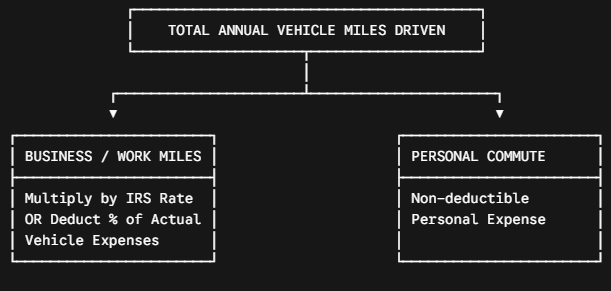
2. Standard Mileage Rate vs. Actual Expense Method
Taxpayers can choose the method that yields the highest tax savings:
| Comparison Metric | Standard Mileage Rate | Actual Expense Method |
| How It Works | Multiply eligible business miles by the annual IRS rate. | Deduct actual business percentage of gas, oil, repairs, insurance, & leases. |
| Depreciation | Includes built-in depreciation allowance. | Allows Section 179 and Bonus Depreciation write-offs. |
| Recordkeeping | Requires date, business purpose, and mileage log. | Requires logbook PLUS all fuel, repair, and insurance receipts. |
| Best For | Fuel-efficient cars, sedans, and high-mileage drivers. | Heavy SUVs/trucks (>6,000 lbs GVWR) and leased luxury vehicles. |
The First-Year Rule
To use the standard mileage rate for a personal vehicle you own, you must choose it in the first tax year the vehicle is placed in service for business. In subsequent years, you can switch between standard mileage and actual expenses. If you start with actual expenses in Year 1, you are locked out of using the standard mileage rate for the life of that vehicle.
3. Unreimbursed Employee Expenses & California Reimbursement Rules
- W-2 Employees (Federal Limit): Under federal tax law, W-2 employees cannot deduct unreimbursed employee business expenses (including vehicle mileage) on federal tax returns.
- California Employer Reimbursement (Labor Code 2802): California state law requires employers to fully reimburse employees for all necessary business expenses incurred on the job. Using the IRS standard mileage rate satisfies California employer reimbursement obligations.
4. IRS Mileage Logbook Rules: Avoiding Audit Disallowances
The IRS routinely disallows vehicle deductions that lack contemporaneous documentation. To withstand an IRS audit, your mileage log (kept via paper or apps like MileIQ) must record:
- Date of the trip.
- Trip starting point and destination.
- Specific business purpose for the travel.
- Total mileage driven per trip.
- Total vehicle odometer reading at the start and end of the tax year.
Optimize Your Vehicle & Business Tax Strategy Today
Choosing between standard mileage and actual vehicle depreciation requires evaluating your vehicle type, business usage percentage, and overall entity structure.
At Moontree Tax Service, we assist small business owners, 1099 contractors, and S-Corporation shareholders across Silicon Valley and California with auto expense modeling, Section 179 planning, and business return preparation.
Schedule a Small Business Tax Consultation Today or call us directly at (408) 475-2306.
Disclaimer: This article is intended solely for educational and informational purposes and does not constitute formal legal, accounting, or tax advice. Tax laws change frequently and apply differently based on individual financial profiles and transaction timing.