
Quick Summary: Under the federal One Big Beautiful Bill Act (OBBBA), the State and Local Tax (SALT) deduction cap quadruples from $10,000 to $40,000 ($20,000 for married filing separately) for tax years 2025 through 2029. High-tax state residents in California can now deduct significantly more in state income, property, and local sales taxes on Schedule A. However, the $40,000 cap phases down by 30% of Modified Adjusted Gross Income (MAGI) exceeding $500,000 ($250,000 MFS), dropping back to a statutory $10,000 floor for high earners. Small business owners can still combine this higher individual cap with California’s Pass-Through Entity (PTE) tax for maximum tax savings.
How the Expanded SALT Deduction Cap Unlocks Huge Federal Tax Relief
Enacted under the federal One Big Beautiful Bill Act (OBBBA), the expansion of the State and Local Tax (SALT) deduction cap offers massive tax relief to homeowners and high-earning professionals in high-tax states like California.
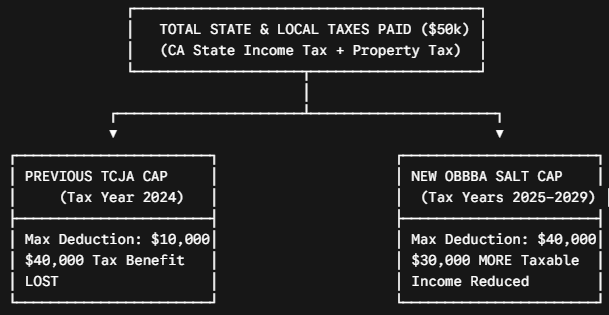
For tax years 2025 through 2029, the cap on deductible state income taxes, real estate property taxes, and local sales taxes increases from the former $10,000 ceiling to $40,000 ($20,000 for married taxpayers filing separately).
Here is a guide explaining how the $40,000 SALT cap works, the high-income MAGI phase-out rules, and how to combine itemized deductions with pass-through entity tax strategies.
1. How the $40,000 SALT Cap Expansion Works
For years, the $10,000 SALT cap imposed under the 2017 Tax Cuts and Jobs Act (TCJA) penalized California residents paying heavy state income and property taxes.
Under OBBBA, taxpayers who itemize deductions on Schedule A (Form 1040) can write off up to $40,000 in combined state and local taxes:
- State Income Taxes: W-2 state tax withholdings, state estimated tax payments, and prior-year state balance-due payments.
- Property Taxes: County real estate property taxes paid on primary personal residences and secondary vacation homes.
- Sales Taxes: Local and state general sales taxes (claimed in lieu of state income taxes for applicable filers).
2. The High-Income MAGI Phase-Out Rules
To prevent ultra-high earners from claiming the full expansion, Congress embedded an income-based phase-out mechanism:
- Phase-Out Threshold: Begins when Modified Adjusted Gross Income (MAGI) exceeds $500,000 for single/joint filers ($250,000 for Married Filing Separately).
- Reduction Rate: The $40,000 cap is reduced by 30% of the excess MAGI above $500,000.
- Statutory Floor: The deduction cannot be reduced below the baseline $10,000 floor. Taxpayers with MAGI exceeding $600,000 revert back to the $10,000 maximum limit.
SALT Cap Reduction Math Example:
A married couple earning $530,000 MAGI pays $45,000 in combined California income and property taxes:
- Excess Income: $530,000 – $500,000 = $30,000 excess MAGI.
- Phase-Out Reduction: 30% x $30,000 = $9,000 reduction.
- Adjusted SALT Cap: $40,000 – $9,000 = $31,000 maximum allowable Schedule A deduction.
3. Combining the $40k SALT Cap with the California PTE Tax
For private practice physicians, partners, and small business owners, the $40,000 individual SALT cap works alongside California’s Pass-Through Entity (PTE) Elective Tax (AB 150).
- Entity-Level Deduction: Your S-Corporation or Partnership pays a 9.3% state tax on qualified net income, generating an above-the-line federal business deduction that bypasses the personal SALT cap entirely.
- Personal Schedule A Stacking: You can then claim up to $40,000 in personal property taxes and remaining state taxes on your personal Schedule A return.
Read our dedicated guide on California PTE Tax Strategy for Physicians and Business Owners.
4. Annual Cap Adjustment Schedule (2025–2030)
The expanded SALT cap features a 1% annual inflation escalator through 2029 before returning to prior levels:
| Tax Year | Max SALT Cap (Single / Joint) | MAGI Phase-Out Threshold |
| 2025 | $40,000 | $500,000 |
| 2026 | $40,400 | $505,000 |
| 2027 | $40,804 | $510,050 |
| 2028 | $41,212 | $515,150 |
| 2029 | $41,624 | $520,302 |
| 2030 & Beyond | $10,000 (Reverts to base TCJA level) | N/A (No phase-out) |
Optimize Your Itemized Tax Strategy Today
Capitalizing on the expanded $40,000 SALT cap requires comparing standard vs. itemized deductions, tracking MAGI phase-out boundaries, and coordinating entity-level tax payments.
At Moontree Tax Service, we specialize in high-net-worth tax planning, Schedule A itemized strategy, PTE tax elections, and real estate wealth preservation across Silicon Valley and California.
Schedule a Tax Strategy Consultation Today or call us directly at (408) 475-2306.
Disclaimer: This article is intended solely for educational and informational purposes and does not constitute formal legal, accounting, or tax advice. Tax laws change frequently and apply differently based on individual financial profiles and transaction timing.