
Quick Summary: Utilizing an Internal Revenue Code Section 1031 tax-deferred exchange on a fourplex allows real estate investors to defer federal capital gains tax, net investment income tax (NIIT), and California state income tax when selling or buying 2–4 unit residential properties. Because fourplexes fall under residential property limits, they combine favorable residential financing terms with full like-kind real estate exchange treatment. Investors can swap single-family rentals for fourplexes, combine Section 121 primary residence exclusions with 1031 deferrals on owner-occupied units, and scale cash flow while completely deferring depreciation recapture.
Maximizing Wealth & Deferring Taxes with Fourplex 1031 Exchanges
Fourplexes (4-unit residential properties) occupy a unique sweet spot in real estate investing. Under federal lending guidelines, properties with 1-4 residential units qualify for standard residential conventional mortgages, lower interest rates, and favorable down payments—yet under tax law, they qualify as full commercial-grade income assets.
When selling or acquiring a fourplex, utilizing an IRC Section 1031 exchange allows real estate investors to roll 100% of their net sale proceeds into replacement real estate without paying current-year federal capital gains taxes (20%), the Net Investment Income Tax (3.8%), or California state income taxes (up to 13.3%).
Here is a comprehensive guide on how 1031 exchanges work for fourplexes, the strict IRS timelines, owner-occupied split rules, and how to avoid taxable “boot.”
1. Why Fourplexes Are Ideal 1031 Exchange Assets
Under Section 1031 rules, replacement real estate must simply be “like-kind”—meaning held for investment or business use. You do not need to exchange a fourplex for another fourplex.
- Exchanging Up: Swap two single-family rentals or a duplex into a higher-cash-flow fourplex.
- Consolidating: Exchange a fourplex into a larger multi-family commercial complex or syndicated Delaware Statutory Trust (DST).
- Favorable Residential Financing: Unlike 5+ unit commercial buildings requiring commercial loans with balloon payments, a 4-unit property retains access to 30-year fixed residential debt structures.
2. Strict IRS Deadlines for Fourplex Exchanges
To maintain tax-deferred status, fourplex exchanges require strict adherence to IRS timelines managed through an independent Qualified Intermediary (QI):
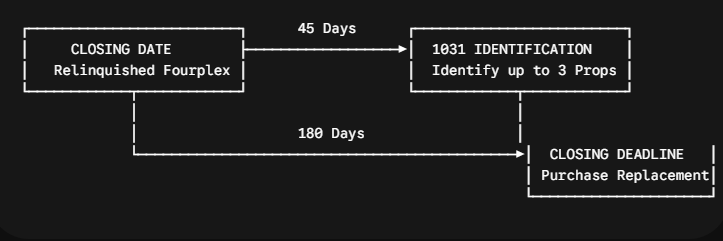
- The 45-Day Identification Rule: Within 45 calendar days of selling your property, you must formally identify potential replacement properties in writing to your Qualified Intermediary (typically using the 3-Property Rule).
- The 180-Day Exchange Period: You must complete the purchase and close escrow on the replacement property within 180 calendar days of the initial sale.
3. Owner-Occupied Fourplexes: Combining Section 121 & 1031
If you live in one unit of the fourplex and rent out the remaining three units, you hold a mixed-use property.
Under IRS Revenue Procedure 2005-14, you can combine the IRC Section 121 primary residence exclusion with an IRC Section 1031 exchange on the exact same closing transaction:
- Unit 1 (Primary Residence – 25% Allocation): Exclude up to $250,000 (single) or $500,000 (married filing jointly) in capital gains tax-free under Section 121. Take this portion as tax-free cash proceeds.
- Units 2, 3, & 4 (Rental Portion – 75% Allocation): Direct the remaining 75% of proceeds to your Qualified Intermediary to execute a Section 1031 exchange into a new investment property.
Read our full guide on Combining Section 121 and 1031 Exchanges.
4. How to Avoid Taxable “Boot” in a Fourplex Exchange
To achieve 100% tax deferral on a fourplex sale, you must avoid creating taxable “boot” (cash or debt relief):
- Reinvest All Net Equity: Every dollar of cash proceeds from the sale must be reinvested into the replacement property. Taking cash out at closing generates cash boot.
- Equal or Greater Debt: Your replacement property debt must be equal to or greater than the mortgage balance paid off on the relinquished fourplex. Decreasing your total debt obligations generates mortgage boot.
Optimize Your Real Estate Tax Strategy Today
Executing a fourplex 1031 exchange requires careful basis allocation, qualified intermediary coordination, and depreciation schedule tracking.
At Moontree Tax Service, we specialize in real estate tax strategy, Schedule E property accounting, 1031 exchange structuring, and capital gains minimization for property investors across Silicon Valley and California.
Schedule a Real Estate Tax Strategy Call Today or call us directly at (408) 475-2306.
Disclaimer: This article is intended solely for educational and informational purposes and does not constitute formal legal, accounting, or tax advice. Tax laws change frequently and apply differently based on individual financial profiles and transaction timing.