Quick Summary: Under Internal Revenue Code Section 1031, real estate investors can defer 100% of federal capital gains tax, Net Investment Income Tax (NIIT), depreciation recapture, and California state income taxes when selling business or investment property. By rolling all net proceeds into a replacement “like-kind” real estate asset through a Qualified Intermediary (QI), property owners preserve equity and accelerate portfolio growth. To maintain tax-deferred status, investors must strictly adhere to the 45-day replacement property identification deadline, close within 180 days, avoid taxable cash or mortgage boot, and comply with California’s state-specific FTB clawback reporting requirements.
Unlocking Infinite Wealth Compounding Through IRC Section 1031 Exchanges
Selling appreciated investment property in California triggers a massive combined tax burden: federal capital gains taxes (up to 20%), federal depreciation recapture (25%), Net Investment Income Tax (3.8%), and California state income taxes (up to 13.3%). Combined, taxes can consume over 40% of your hard-earned real estate equity.
An IRC Section 1031 Exchange provides a legal mechanism to defer 100% of these liabilities, allowing investors to reinvest their entire gross equity into cash-flowing replacement properties.
Here is a guide on how a 1031 exchange works, the qualifying rules, critical IRS deadlines, and California-specific Franchise Tax Board (FTB) compliance.
1. What Is a 1031 Exchange and How Does It Work?
A 1031 exchange allows a property owner to sell an investment or business property (the Relinquished Property) and acquire a new investment or business property (the Replacement Property) without recognizing current-year capital gains or depreciation recapture.
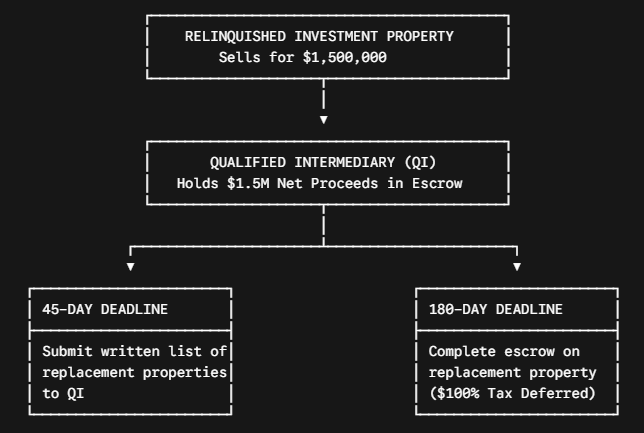
The Standard 4-Step Exchange Process:
- Purchase Agreement: Include 1031 exchange cooperation language in your purchase and sale contract.
- Engage a Qualified Intermediary (QI): Prior to closing escrow on the sale, assign the transaction to an independent QI. The QI holds all sale proceeds in a secure escrow account—you cannot touch the cash directly.
- Identify Replacement Property: Formally submit your written list of potential replacement properties to your QI within 45 days.
- Close on Replacement Property: Direct your QI to release funds from escrow to purchase the replacement real estate within 180 days.
2. What Qualifies as “Like-Kind” Real Estate?
A common misconception is that “like-kind” requires exchanging the exact same property type. Under federal tax law, all real property located within the United States held for investment or productive business use is like-kind to all other U.S. real property.
- Qualifying Exchanges:
- Single-Family Rental –> Multi-Family Apartment Complex
- Commercial Office Building –> Industrial Warehouse
- Raw Investment Land –> Retail Shopping Center
- Residential Rental –> Fourplex or Delaware Statutory Trust (DST)
- Non-Qualifying Property: Primary personal residences, second homes used strictly for personal enjoyment, properties held primarily for sale (fix-and-flip inventory), and foreign real estate.
Read our specialized guide on executing a 1031 Exchange on a Fourplex.
3. How to Avoid Taxable “Boot”
To achieve 100% tax deferral, you must avoid generating “boot”—which represents non-like-kind value received during the exchange. Boot is fully taxable up to the amount of total gain realized on the property sale.
- Cash Boot: Occurs when you receive cash proceeds at closing or fail to reinvest all net equity from the sale into the replacement property.
- Mortgage (Debt) Boot: Occurs when the liability/mortgage balance on your replacement property is less than the mortgage balance paid off on your sold property. To avoid debt boot, you must acquire replacement debt equal to or greater than the original debt (or replace the deficit with fresh personal cash).
4. California FTB Clawback Rules (Form 3840)
California enforces strict rules regarding 1031 exchanges under the Franchise Tax Board (FTB) Clawback Provision.
If you sell a property located in California and execute a 1031 exchange into a replacement property located out-of-state (e.g., Texas, Florida, or Nevada), California tracks that deferred gain indefinitely.
- Mandatory Annual Filing: You must file FTB Form 3840 annually with the state of California for as long as you hold that out-of-state replacement property.
- The Clawback Trigger: When you eventually sell the out-of-state replacement property in a fully taxable transaction, California will tax the original gain generated within California borders.
Optimize Your Real Estate Tax Strategy Today
Executing a 1031 exchange requires careful coordination between your legal team, Qualified Intermediary, real estate broker, and CPA.
At Moontree Tax Service, we specialize in real estate tax strategy, Schedule E accounting, 1031 exchange modeling, combined Section 121/1031 planning, and California FTB Form 3840 compliance for real estate investors across Silicon Valley and California.
Schedule a Real Estate Tax Strategy Call Today or call us directly at (408) 475-2306.
Disclaimer: This article is intended solely for educational and informational purposes and does not constitute formal legal, accounting, or tax advice. Tax laws change frequently and apply differently based on individual financial profiles and transaction timing.