Quick Summary: Proposals for government-funded “Trump Accounts” or federal newborn seed grants aim to provide every American child with a $1,000 tax-advantaged investment foundation at birth. Designed to promote compound wealth accumulation and financial literacy, these proposed accounts function similarly to “Baby Bonds,” allowing funds to grow tax-deferred until the child reaches adulthood. Parents evaluating long-term wealth strategies for children can maximize immediate tax benefits by utilizing established vehicles, such as 529 College Savings Plans (which now offer $35,000 tax-free Roth IRA rollover allowances under SECURE 2.0) and Custodial Roth IRAs for children with earned income.
Evaluating Federal Newborn Seed Accounts & Tax-Advantaged Family Wealth Building
Proposals surrounding federal investment accounts for children—frequently referred to in policy discussions as “Trump Accounts” or government-funded newborn seed grants—aim to address wealth inequality by providing every American child with an initial financial foundation at birth.
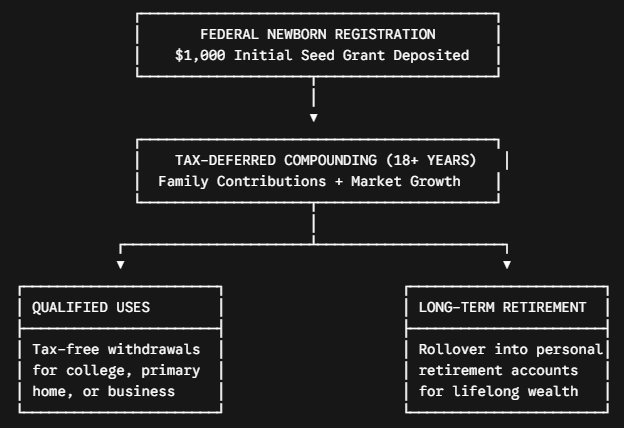
Under proposed frameworks, the federal government would deposit a $1,000 initial seed grant into a tax-advantaged account for eligible newborns, allowing families to make annual non-taxable contributions that compound tax-deferred until the child reaches majority age.
Here is an analysis of how proposed newborn seed accounts function, their tax implications, and the existing tax-advantaged vehicles parents can use today to build multi-generational family wealth.
1. How Proposed Newborn Seed Accounts Function
While specific legislative details vary across policy proposals, the general mechanics of government-seeded newborn accounts follow a structured framework:
- Initial Federal Grant: The government deposits a baseline $1,000 contribution into a tax-deferred investment account upon the registration of a newborn child’s Social Security Number.
- Family Supplemental Contributions: Parents, grandparents, and relatives can make additional annual contributions up to designated statutory caps.
- Compound Growth: Funds are invested in broad-market index funds, growing tax-deferred for 18 to 21 years.
- Qualified Distributions: Upon reaching adulthood, the beneficiary can access funds tax-free for qualified uses, such as higher education, a first-time home purchase, or starting a small business.
2. Existing Alternatives: 529 Plans & The SECURE 2.0 Roth Rollover
While federal newborn account proposals navigate the legislative process, parents do not need to wait to start building tax-advantaged wealth for their children.
529 College Savings Plans
A 529 Plan offers tax-free growth and tax-free withdrawals for qualified education expenses (including tuition, K-12 private schooling, and apprenticeship programs).
- SECURE 2.0 Act Benefit: Under current tax law, families can roll over up to $35,000 in unused 529 plan funds directly into a Roth IRA for the beneficiary tax-free and penalty-free (provided the 529 account has been open for at least 15 years).
- Estate Tax Advantages: High-net-worth parents and grandparents can front-load up to 5 years of annual gift tax exclusions into a 529 plan in a single year ($90,000 for single filers or $180,000 for married couples filing jointly) without triggering gift taxes.
3. Custodial Roth IRAs for Children with Earned Income
If a child earns legitimate income (e.g., modeling, family business employment, acting, or household chores subject to W-2 reporting), parents can establish a Custodial Roth IRA.
- Tax-Free Growth Forever: Contributions are made with after-tax dollars, but all growth and earnings can be withdrawn completely tax-free in retirement.
- Contribution Limit: Parents can contribute up to $7,000 annually (or 100% of the child’s earned income, whichever is less).
- Family Business Strategy: Employing children through a family S-Corporation or Sole Proprietorship allows business owners to deduct reasonable wages as a business expense while funding the child’s Custodial Roth IRA.
4. Structuring Family Wealth & Tax Strategy
Integrating family savings accounts into your overall tax plan requires coordinating gift tax rules, business entity structures, and long-term estate planning:
- Pass-Through Entities: Utilizing the California PTE Tax (AB 150) allows small business owners and medical practice partners to optimize personal cash flow to fund family investment vehicles.
- Real Estate Wealth Transfer: Investors utilizing a 1031 Exchange on Real Estate can preserve real estate basis to pass down appreciated properties through stepped-up basis rules.
Build Your Family’s Financial Future Today
Optimizing tax-advantaged accounts for your children requires long-term planning, contribution tracking, and strategic wealth coordination.
At Moontree Tax Service, we specialize in family wealth planning, business entity structuring, 529 rollover coordination, and high-net-worth tax strategy for clients across Silicon Valley and California.
Schedule a Family Tax Strategy Consultation Today or call us directly at (408) 475-2306.
Disclaimer: This article is intended solely for educational and informational purposes and does not constitute formal legal, accounting, or tax advice. Tax laws change frequently and apply differently based on individual financial profiles and legislative updates.