
Quick Summary: Under the federal “One Big Beautiful Bill Act” (OBBBA), taxpayers aged 65 and older can claim an additional $6,000 tax deduction ($12,000 for qualifying married couples) for tax years 2025 through 2028. This new “Senior Deduction” stacks directly on top of the standard deduction and the existing age 65+ additional standard deduction—regardless of whether you take the standard deduction or itemize. Full tax relief is available for single filers with MAGI under $75,000 ($150,000 for married couples filing jointly) and gradually phases out for higher earners.
Maximizing the Federal OBBBA $6,000 Senior Tax Deduction & Retirement Strategies
Enacted as part of the federal One Big Beautiful Bill Act (OBBBA), the Senior Tax Deduction provides significant tax relief for older Americans navigating retirement income, Required Minimum Distributions (RMDs), and inflation.
For tax years 2025 through 2028, eligible individuals aged 65 and older can deduct an additional $6,000 from federal taxable income, while married couples where both spouses qualify can deduct $12,000.
Here is a guide explaining eligibility requirements, MAGI phase-out calculations, Social Security tax impacts, and proactive retirement planning strategies.
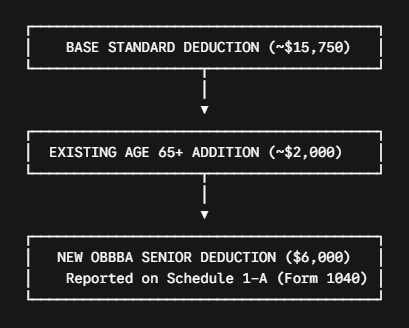
1. How the Three-Tier Senior Deduction “Stack” Works
A major advantage of the $6,000 Senior Deduction is that it stacks on top of existing tax write-offs. It does not replace the standard deduction or the age 65+ additional standard deduction.
Standard Deduction Breakdown for Age 65+ Filers:
- Base Standard Deduction: Available to all federal tax filers.
- Existing Senior/Blind Addition: Additional amount granted automatically to filers age 65 and older.
- NEW OBBBA Senior Deduction: Additional $6,000 deduction per eligible individual reported on Schedule 1-A.
2. Eligibility & MAGI Phase-Out Thresholds
To qualify for the full $6,000 deduction, taxpayers must meet strict IRS guidelines:
- Age Test: Must be 65 or older by December 31 of the tax year.
- Filing Status: Single, Head of Household, or Married Filing Jointly. (Taxpayers using Married Filing Separately are ineligible).
- Identification: Must possess a valid work-authorized Social Security Number.
Income Phase-Out Ranges
The deduction begins to phase out at 6% of Modified Adjusted Gross Income (MAGI) above the threshold limits:
| Filing Status | Full Deduction Threshold | Partial Deduction Phase-Out | Fully Phased Out |
| Single / Head of Household | MAGI under $75,000 | $75,000 – $175,000 | MAGI over $175,000 |
| Married Filing Jointly (Both 65+) | MAGI under $150,000 | $150,000 – $250,000 | MAGI over $250,000 |
3. Impact on Social Security & Retirement Income Strategies
While the law did not directly change the taxation formula for Social Security benefits, the additional $6,000–$12,000 write-off drastically reduces—or completely eliminates—federal tax liability on Social Security income for the vast majority of retirees.
Tactical Opportunities (2025–2028 Window)
Because this enhanced deduction is temporary, retirees can leverage the temporary higher tax shelter to execute strategic financial moves:
- Strategic Roth Conversions: Convert Traditional IRA/401(k) funds to Roth IRAs up to the top of your marginal tax bracket, using the $6,000 deduction to absorb the income tax hit without triggering higher out-of-pocket tax bills.
- Managing Required Minimum Distributions (RMDs): Lower future taxable RMDs by reducing traditional pre-tax balances while the senior deduction is active.
- IRMAA Planning: Note that MAGI is calculated before below-the-line deductions. The senior deduction lowers taxable income on Form 1040, but does not alter Medicare Part B/D IRMAA surcharge calculations.
Read our guide on combining family retirement vehicles via 529 Plans and Custodial Roth IRAs.
Optimize Your Retirement Tax Strategy Today
Navigating retirement tax legislation requires proactive income modeling, Roth conversion execution, and MAGI tracking.
At Moontree Tax Service, we assist retirees, business owners, and real estate investors across Silicon Valley and California with comprehensive retirement tax planning, RMD management, and annual return preparation.
Schedule a Retirement Tax Strategy Call Today or call us directly at (408) 475-2306.
Disclaimer: This article is intended solely for educational and informational purposes and does not constitute formal legal, accounting, or tax advice. Tax laws change frequently and apply differently based on individual financial profiles and transaction timing.